
The “October Revolution” of 1917 put an end to anti-Semitism as a state policy in the newly created Land of the Soviets. Officially, Judeophobia was considered as a negative legacy of the Russian Empire and was opposed to the idea of proletarian internationalism that prevailed in the 1920s in the USSR. Subsequently, the ideology of internationalism was replaced by “Soviet patriotism”, in which the role of the unifier of “fraternal” nations was assigned to the russians. However, even then, a positive attitude towards Jews was maintained. However, already in the second half of the 1930s, manifestations of anti-Semitism took on a national scale. This process stopped during World War II. With the beginning of the German-Soviet war, the USSR government even initiated the creation of the Jewish Anti-Fascist Committee (EAK). In the post-war years, the UAK was liquidated on charges of anti-Soviet propaganda and nationalist activities, which was the beginning of an outright anti-Semitic campaign.
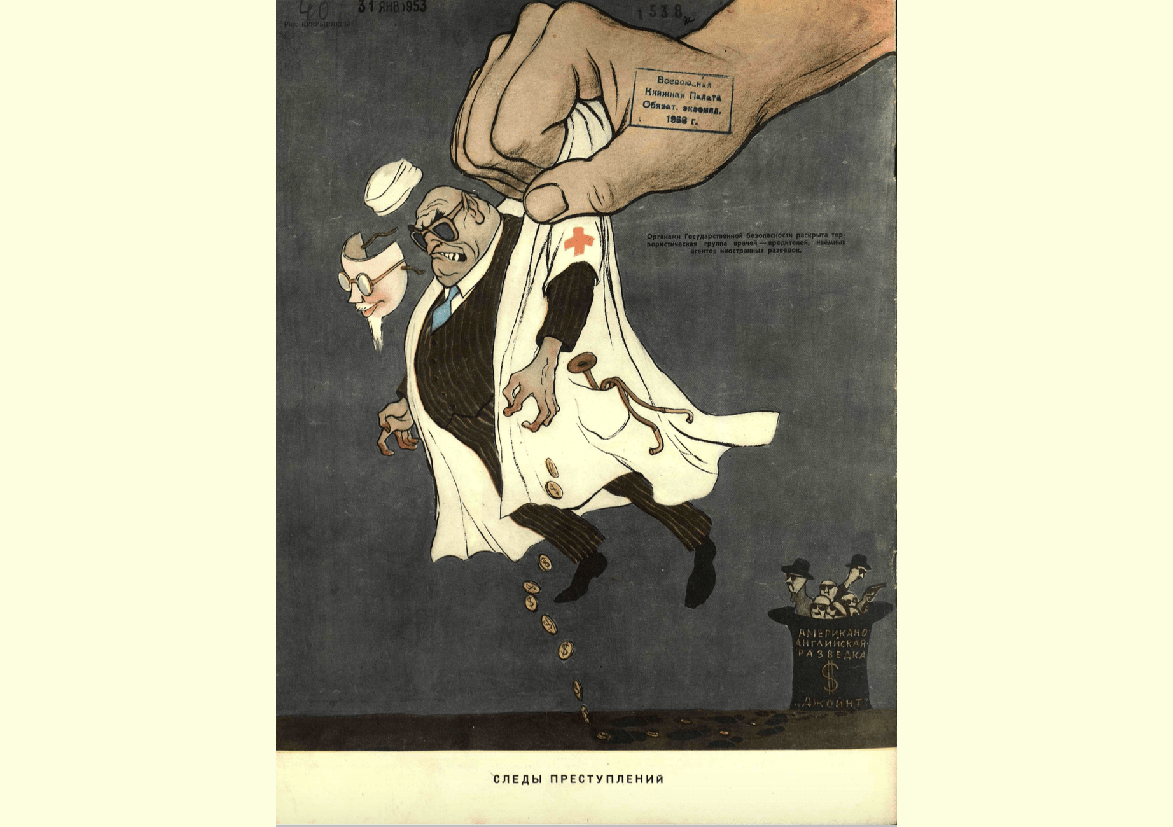
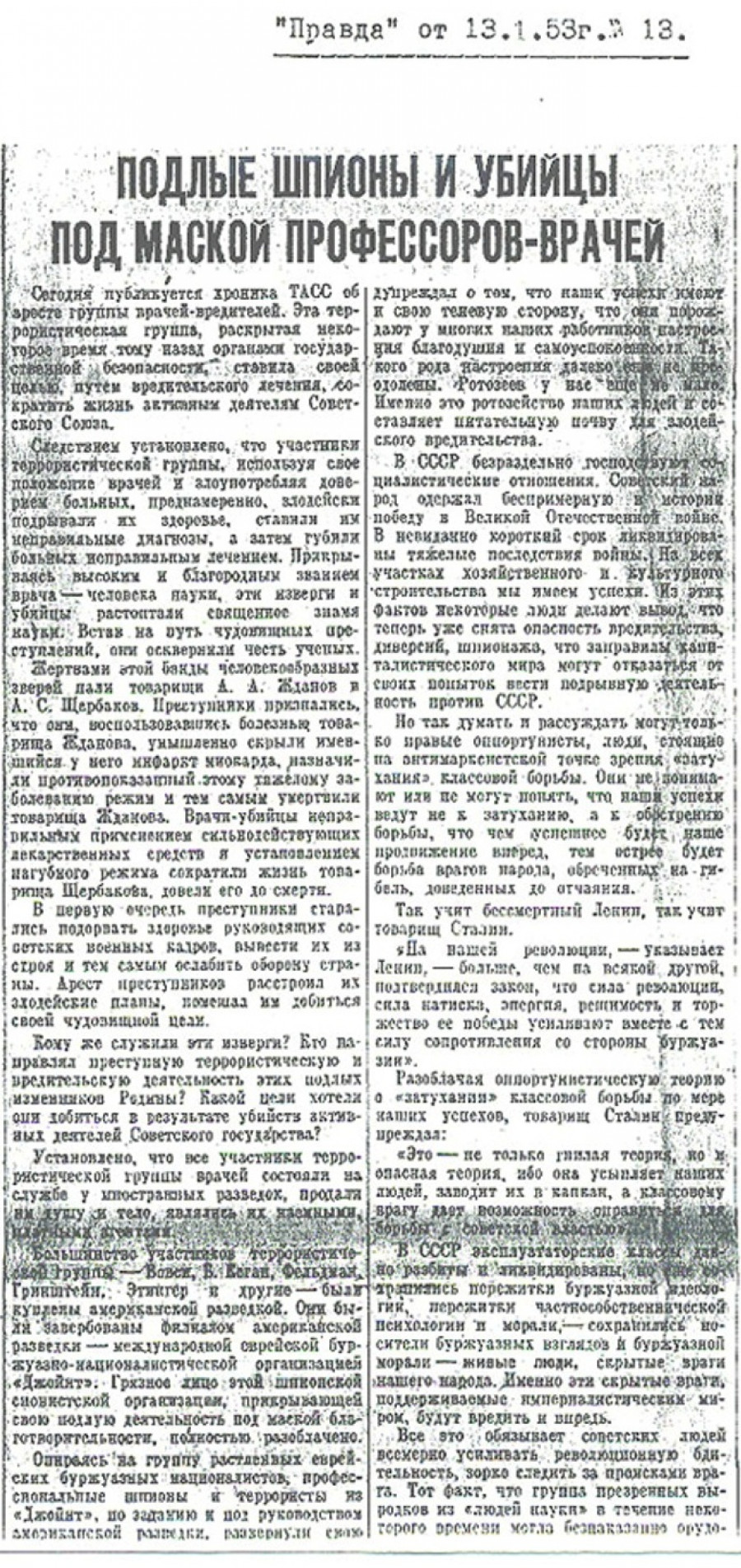
The peak of Soviet state anti-Semitism was the so-called “Doctors' plot”. At the end of 1952 - at the beginning of 1953, a number of outstanding Soviet doctors (most of them of Jewish origin) who treated the first leaders of the USSR, primarily Y. Stalin, were arrested. They were accused of trying to destroy the top leadership of the state. In the text of the official announcement about the arrest, it was announced that “most of the members of the terrorist group (M. S. Vovsi, B. B. Kogan, A. I. Feldman, A. M. Grinstein, Y. G. Ettinger and others) were “associated with the international Jewish bourgeois-nationalist organization “Joint[i]", created by American intelligence allegedly to provide material assistance to Jews in other countries.” The persons involved in the case of the UAC were previously accused of having ties to the same organization. Reports of the doctors' arrest and details of the “conspiracy” appeared in an unsigned article entitled “Insidious spies and murderers in the guise of professor-doctors” published in the central Soviet newspaper Pravda on January 13, 1953. The article, like the government announcement, emphasized on the Zionist nature of the case.
The propaganda presented L. Tymashuk as the heroine who exposed the “murderers in white coats”, a doctor who complained to the Central Committee about the improper treatment of A. Zhdanov back in 1948. “For her help in exposing the thrice-damned murderous doctors” Order of Lenin.
The “doctors' plot” caused the persecution of relatives and colleagues of those arrested, as well as a wave of anti-Semitic sentiments throughout the country. Unlike the previous campaign against the so-called “rootless cosmopolitans”, which most likely meant Jews, now the propaganda pointed directly to them. Anti-Semitic hysteria was fueled by the Soviet press.
Further large-scale development of the campaign was prevented by the death of Y. Stalin on March 5, 1953, after which the wave of anti-Semitism went into decline. All those arrested in connection with the “doctors' plot” were released on April 3, 1953 and returned to work. The very next day, it was officially announced that the confessions of the accused were obtained using “inadmissible investigative methods.” The anti-Semitism of the Stalin era ended, but as a direction of purposeful state policy of the USSR, it flourished under the rule of L. Brezhnev.
Dilfuza Hlushchenko
[i] Joint (Eng. American Jewish Joint Distribution Committee, JDC) – the largest Jewish charitable organization, established in 1914 in the USA