On November 6, 1941, by order of the SS Police Major General of the Galician District, Fritz Katzmann, a Jewish ghetto was established in Lviv, one of the largest in Nazi-occupied Europe. The establishment of the ghetto marked a radically new and, in fact, fatal stage in the history of Galician and Lviv Jewry. By the fall of 1943, about 250,000 Jews had been killed in it, as well as behind the barbed wire of the Yaniv camp.
Eight decades later, in 2023, a woman visited the Memorial Museum of Totalitarian Regimes “Territory of Terror” (Lviv) and, wishing to remain anonymous, handed over a folder with documents to the staff. As it turned out later, the transferred folder contained a kind of archive of the Jewish Rosenthal family, the materials of which chronologically cover the period from 1838 to 1960.
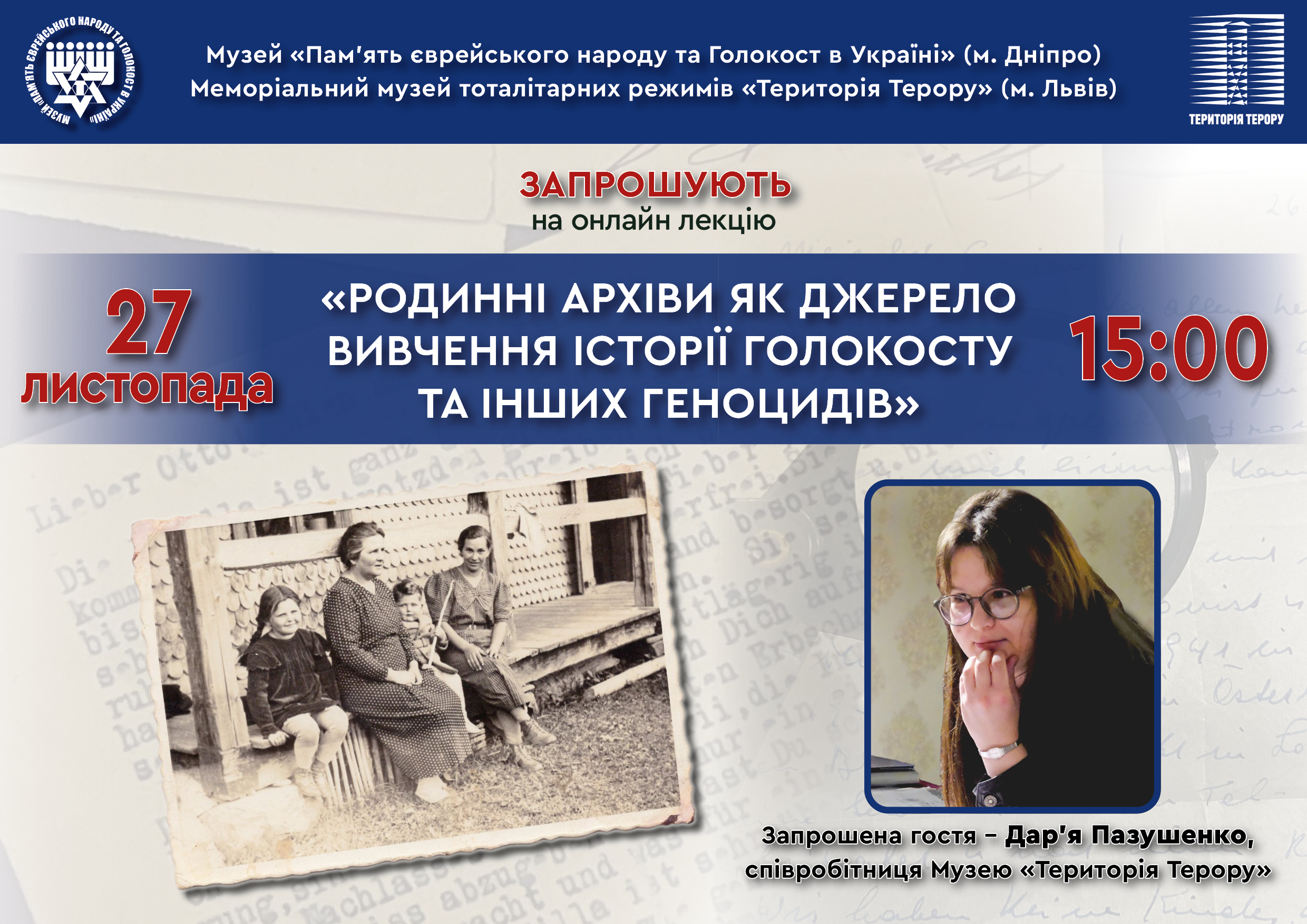
On November 27 (Thursday) at 3:00 PM, the Museum “Jewish Memory and Holocaust in Ukraine” (Dnipro) invites you to a lecture-talk by Daria Pazushenko, museum curator, research associate of the Memorial Museum of Totalitarian Regimes “Territory of Terror” (Lviv) entitled “Family Archives as a Source for Studying the Holocaust History and Other Genocides.”
During the lesson, we will talk about the Rosenthal family archive as a testimony of life before, during and after World War II – through the history of one Jewish family living in Lviv.
Together, let's look at archival documents and photographs and try to “peek” into the everyday life of a Lviv Jewish family on the eve of the war that turned their world upside down.
Let's consider what opportunities family archives open for teachers and history lecturers and help to “revive” the past, and, therefore, to more deeply understand its lessons.
You can join the meeting via the link:
https://us06web.zoom.us/j/82018263704?pwd=LTgeaKlY9mV1wHfSB7Hbx8F7apb6ju.1
Conference ID: 820 1826 3704
Access code: 258969