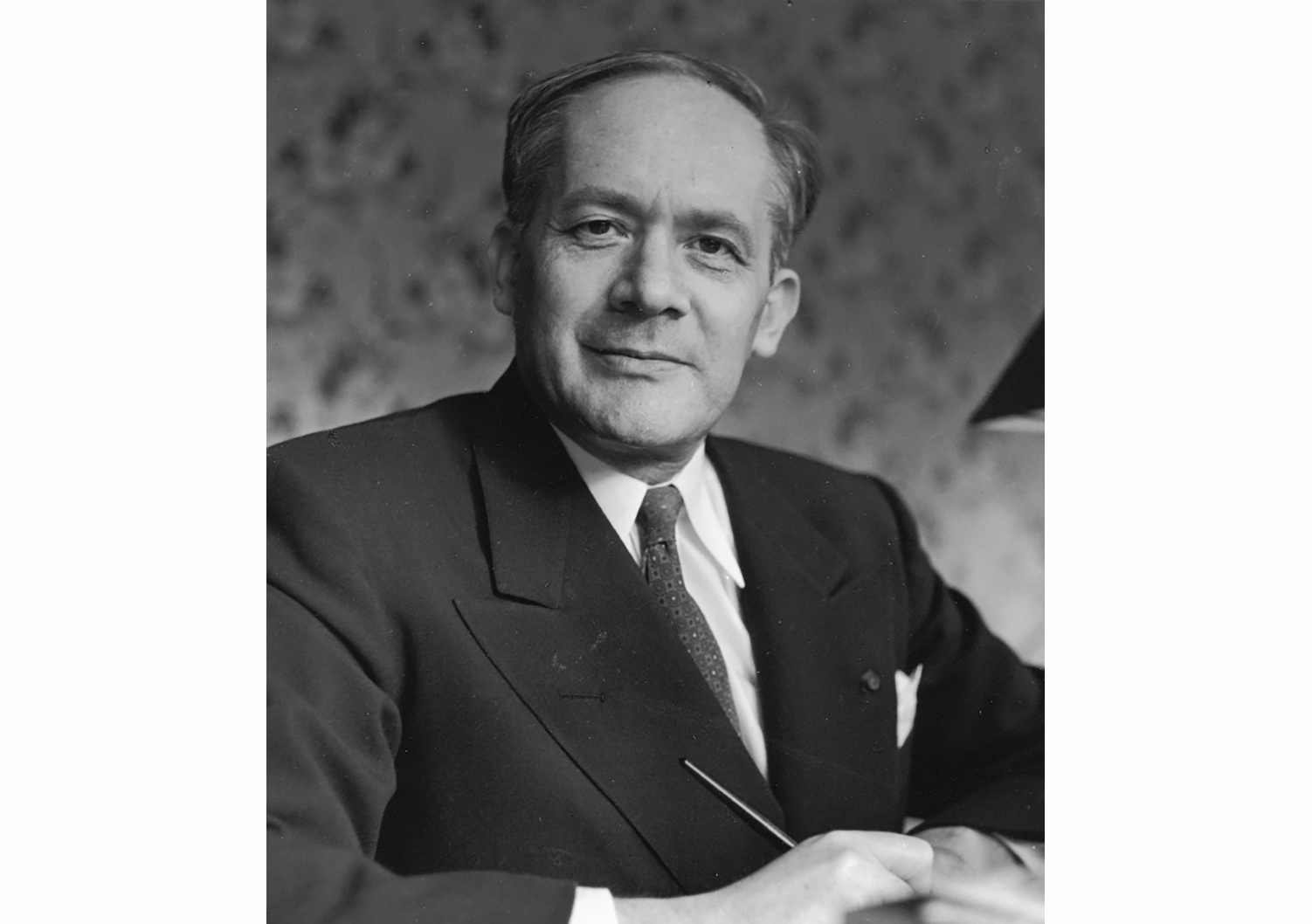
June 24, 1900, Raphael Lemkin was born – a lawyer, human rights activist, developer of the concept of genocide, one of the first to propose qualifying the Holodomor of 1932–1933 as genocide.
Born into a Jewish family in the Grodno Governorate of the Russian Empire (now Belarus). The family spoke Yiddish, Polish, and Russian. R. Lemkin received his secondary education in Białystok (Poland). He studied law at the Jagiellonian University in Krakow and at the Jan Casimir University in Lviv.
R. Lemkin made the choice to study international law under the influence of the assassination in 1921 of Talaat Pasha, one of the Turkish statesmen responsible for the mass murders of Armenians in the Ottoman Empire. Talaat Pasha was shot dead by Sologon Teylirian (a victim of the Armenian Genocide, the only survivor of his family) in Berlin in 1921. R. Lemkin regretted that there was no international law and a corresponding judicial system for punishing offenders, perpetrators of mass murders. After receiving his doctorate (1926), he worked as an assistant prosecutor in the city of Berezhany (now the Ternopil region). From 1929 - a lecturer and freelance lawyer in Warsaw.
In 1939, after the division of Poland by Nazi Germany and the USSR, R. Lemkin joined the Polish army and took part in the defense of Warsaw. Later he was forced to emigrate. First to Lithuania, from there to Sweden, then to the USA. An interesting fact is that he reached the USA in transit through the USSR.
Most of R. Lemkin's family perished during the Holocaust. This tragic page motivated the legal scholar to work even harder on developing the concept of genocide.
In 1944, he published the book “Axis Rule in Occupied Europe” – a detailed documented exposure of Nazi crimes in Europe. The work first uses the term "genocide" and presents its concept as an international crime. In 1945-1946, he was an advisor to the US Supreme Court at the Nuremberg Trials. The term was repeatedly mentioned in the trial documents but never entered the final text of the verdict. The term “genocide” he introduced gained international recognition. Thanks to his book and his activity as a scientist, on December 9, 1948, the United Nations General Assembly adopted the “Convention on the Prevention and Punishment of the Crime of Genocide.”
In 1953, R. Lemkin delivered a speech entitled “Soviet Genocide in Ukraine” to an audience of 3,000 gathered at Manhattan Center in New York to commemorate the 20th anniversary of the Great Famine of 1931–1933. “This is not just mass murder. This is genocide, the extermination not only of individuals but also of a culture and a nation,” the lawyer declared at the time. He described the Holodomor as “a classic example of Soviet genocide.” “As long as Ukraine maintains its national unity, if its people continue to think of themselves as Ukrainians and strive for independence, it poses a serious threat to the very essence of Sovietism…. For the Ukrainian is not and never has been a Russian. His culture, his temperament, his language, his religion are different. Despite his dependence on Moscow, he refused collectivization, preferring deportation and even death.”.
R. Lemkin's ideas are important not only for history, but also for the present, when Russia is killing the civilian Ukrainian population and destroying the Ukrainian nation.
In 2009, his work “Soviet Genocide in Ukraine” was published in 28 languages.
In 2015, the Russian Federation added Raphael Lemkin's works about the Soviet genocide in Ukraine to the “federal list of extremist materials.”
On November 11, 2017, a memorial plaque was installed on Zamarstynivska Street in Lviv, the house where R. Lemkin lived while studying at Jan Casimir University.
On December 19, 2024, the Lviv City Council adopted a decision to rename Malinova Street in honor of Raphael Lemkin.
Iryna Piskareva